
The Peacock Window of Bhaktapur: Newar Woodcarving
In Bhaktapur's Tachupal Tole, the Pujari Math holds the 15th-century Peacock Window, which Lonely Planet describes as "widely regarded as the finest carved window in the Kathmandu Valley". Here is what the sources say about the window, the building that holds it, and how a peacock window reads in wood, with one carved example from the store.
The window and Pujari Math
Lonely Planet describes the Pujari Math as the best known of the ornate brick-and-timber buildings that flank Tachupal Tole, originally a math, or Hindu priests' house, and now the Woodcarving Museum. It reports that the building was first constructed in the 15th century during the reign of King Yaksha Malla, and rebuilt in 1763. The Asia InCH encyclopedia of intangible cultural heritage describes the National Woodworking Museum as housed in a restored fifteenth-century building known as Pujarimath, adorned with exquisitely carved wooden windows, including the famous peacock window and other latticed windows.
How the peacock becomes the lattice
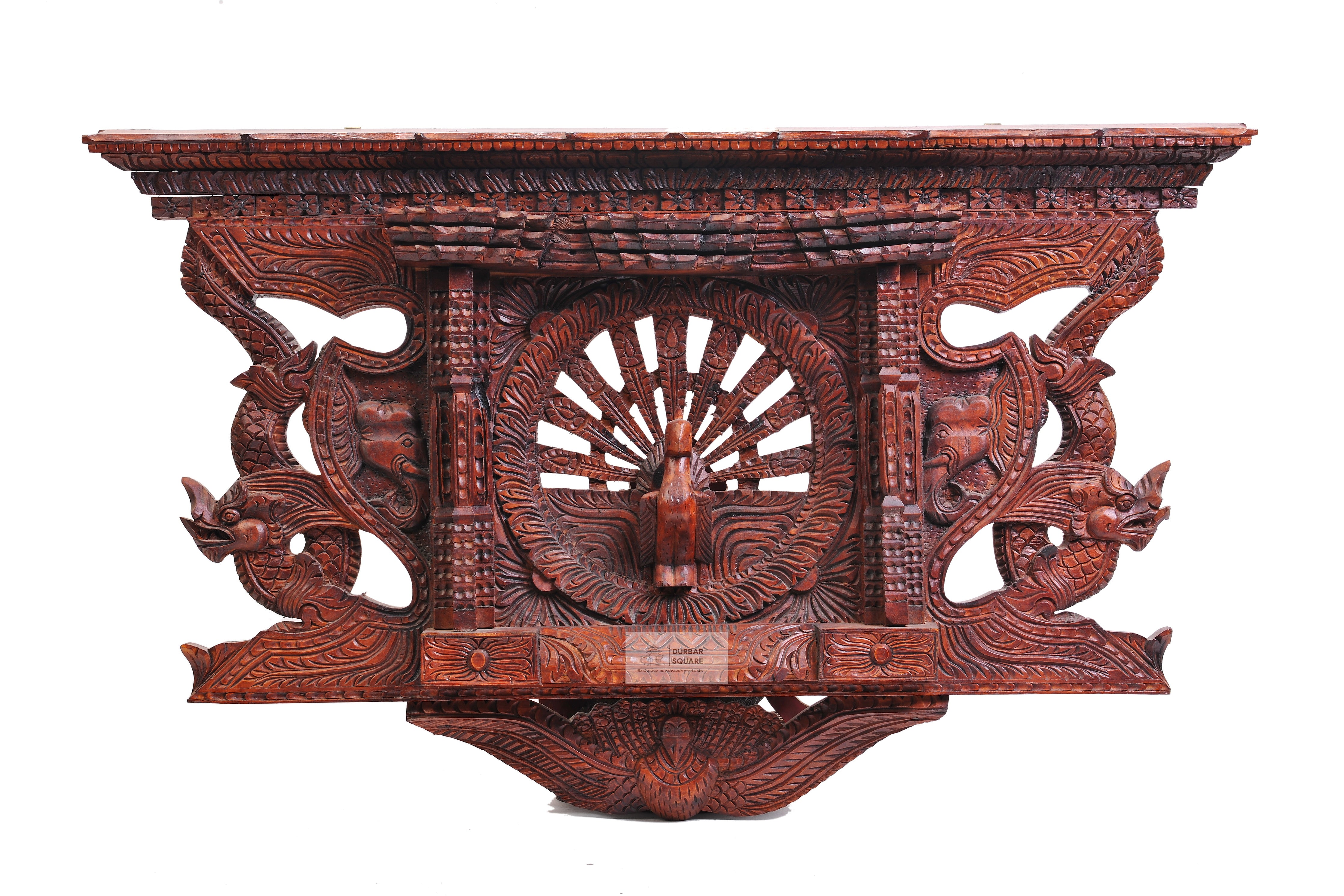
The site bhaktapur.info describes the window, also known as Mhaykha Jhya, as renowned for a beautifully carved peacock surrounded by a radial pattern of feathers and elaborate floral decorations. It says the window's lattice is formed by the outstretched feathers of the peacock at the center, and that the surrounding woodwork shows the skill of medieval Newar craftsmen. Lonely Planet adds that many surrounding shops sell miniature wooden copies of the Peacock Window as souvenirs.
A closer look: the store's peacock window
The store's Carved Peacock Wooden Window (Mhaykhā Jhyā) ($342) is described in its listing as a handcarved wooden peacock window, one of the Newar windows crafted by Newari artisans. The listing is about this piece alone and does not describe it as a copy of the Bhaktapur window. In the photo, a peacock stands at the center of a round frame, its tail feathers fanned out as openwork spokes. Dragon-like creatures with open mouths and elephant heads flank the circle, a tiered eave runs across the top, and a carved winged figure sits beneath. The wood carries a reddish-brown finish.
Related reading
For the wider tradition of carved Newar windows, see our articles on ankhi jhyal, the Newari eye window and the history of Newari windows.