Jade Buddha Statues: Nephrite, Jadeite and What to Know Before You Buy
A jade Buddha statue joins two things people have long valued: a beautiful ornamental stone and the image of the Buddha. If you are weighing a purchase, it helps to know what "jade" actually means, why the stone commands the prices it does, and what to ask before you buy. This guide covers all three, using reference sources for the material and the store's own listing for the piece itself.
Jade is two different stones
As Wikipedia explains, jade is an umbrella term for two different decorative rocks: nephrite, a silicate of calcium and magnesium, and jadeite, a silicate of sodium and aluminum. Nephrite is typically green, though it can be yellow, white or black. Jadeite runs from white or near-colorless through many shades of green, including an emerald green known as "imperial", to lavender, yellow, orange, brown and black. Two chemically different stones share one name, which is part of what makes jade worth understanding before comparing pieces.
Why jade is prized
Wikipedia calls jade "well known for its ornamental use in East Asian, South Asian, and Southeast Asian art". In the history of Chinese art, Wikipedia describes jade's significance as comparable with that of gold and diamonds in the West: it was considered the "imperial gem", used for the finest objects and cult figures and for grave furnishings for high-ranking members of the imperial family. Wikipedia also notes that Myanmar is estimated to be the origin of upwards of 70% of the world's high-quality jadeite, and records an Indian example: the Jain temple of Kolanpak in Telangana houses a 5-foot (1.5 m) sculpture of Mahavira carved entirely out of jade.
Type A, B and C: the buyer's shorthand
Wikipedia describes a three-way classification buyers meet in the market. Type A jade is natural, untreated jadeite, prized for its purity and color; it is the most valuable of the three. Type B has been enhanced with resin, and Type C with colorant. The practical takeaway is simple: treated stone is worth less than untreated stone, so it is always fair to ask a seller whether a piece is natural and untreated.
An honest note on "jade Buddha" history
The reference sources above document jade as a material, not a distinct tradition of jade Buddha statues. The carved-jade sacred figure Wikipedia records in India is Jain, not Buddhist, and none of these sources traces jade Buddha carving in Nepal or Tibet specifically. So this article makes no historical claims about jade Buddhas as a category; what can be said reliably concerns the stone itself and the individual piece in front of you.
The vitarka mudra
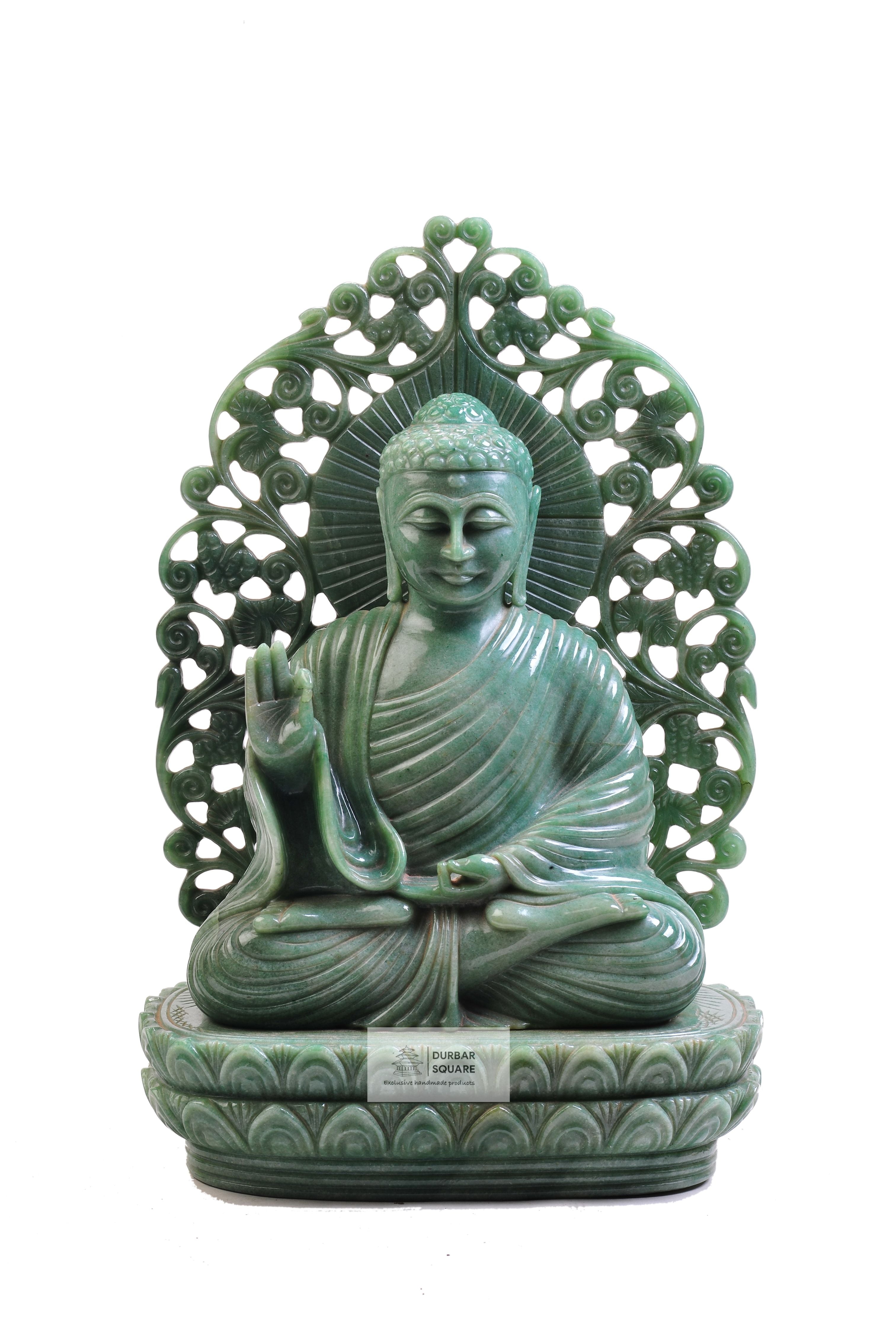
Durbar Square's jade Buddha is carved in the vitarka mudra. According to the store's own description, the vitarka mudra is the gesture representing the discussion and transmission of the Buddha's teachings, also taken, in the listing's words, as the hand gesture which induces the energy of the teachings and discussions of spiritual principles. The store's description also presents a jade Buddha as a feng shui decor piece for the home, citing what it calls the soothing and wise energy of jade as a match for the Buddha; that is the store's framing, offered here as its own product description rather than an independently sourced tradition.
The piece itself
Durbar Square carries a handcarved jade Buddha statue in vitarka mudra, priced at $8,034. In the listing photo, the Buddha sits cross-legged on a lotus pedestal, the right hand raised at the chest in the teaching gesture, backed by an intricately carved openwork halo, all in green stone. It appears in the store's Buddha Statues collection.