
Kangiten: Japan's Elephant-Headed Deva of Bliss
Kangiten - the name is Japanese for "god of bliss" - is a deva venerated mainly in the Shingon and Tendai schools of Japanese Buddhism, and Wikipedia identifies him as the Buddhist equivalent of the Hindu deity Ganesha. He is also known as Shoten or Shoden, and by the Sanskrit-derived name Binayaka, from Vinayaka. Though he and Ganesha share a common origin and a number of traits, Wikipedia notes marked differences between the two - beginning with the fact that the Buddhist Vinayaka was at first a figure to be feared.
From obstacle-maker to protector
Where Hinduism regards Ganesha mainly as a remover of obstacles, Wikipedia explains that Buddhists originally emphasized his destructive side: early Buddhist texts give the name Vinayaka a negative connotation, as a malignant being who causes obstacles, even a demon king obstructing practice. In esoteric Buddhist literature, as the same source describes, he is the enemy of the ritual practitioner, to be expelled with mantras or soothed with offerings - but once duly propitiated, he turns into the practitioner's ally, a protecting deity who removes impediments. Later tradition, Wikipedia adds, came to see him as a manifestation of the bodhisattva Avalokiteshvara - Kannon in Japanese - and of the buddha Vairochana.
The embracing couple
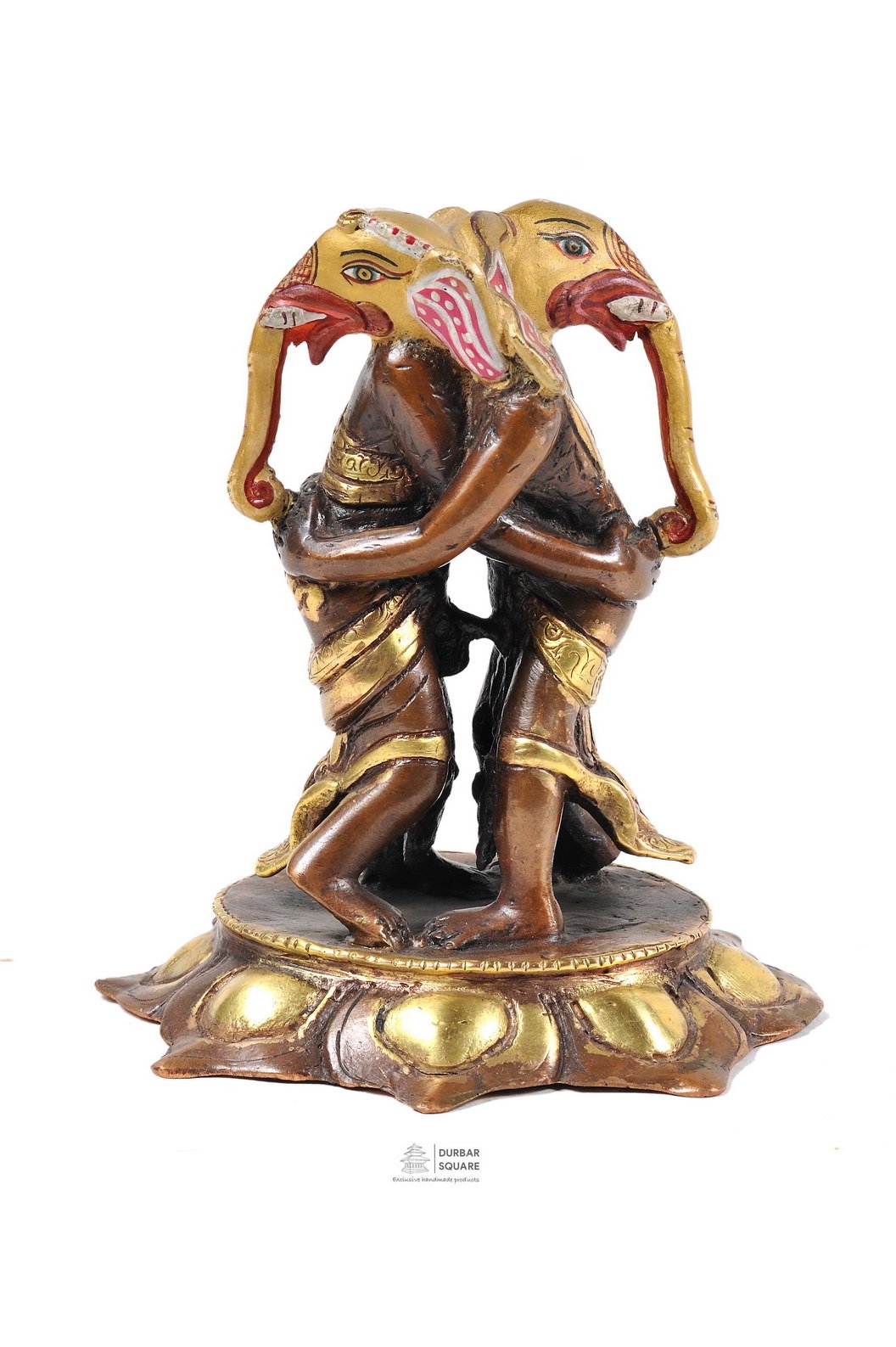
While Kangiten is sometimes shown as a single elephant-headed male deity like Ganesha, Wikipedia notes he is more commonly portrayed as a male-female couple, both elephant-headed, standing in an embrace - the Dual-bodied Kangiten, or Soshin Kangiten. The origins of this imagery, unique to East Asia, have perplexed scholars, and Wikipedia records no concrete evidence for its inception; the form is first attested in 7th-8th century Chinese esoteric Buddhist texts, including a ritual for worshipping the Dual Vinayaka in a sutra translated by the monk Atigupta in 653-654 CE, replicated by Amoghavajra in his own ritual text. The late Heian period, the same source says, saw the image's rise in popularity in Japan.
The legend behind the dual form
Wikipedia recounts the story found in Shubhakarasimha's ritual manual: Maheshvara's wife Uma gave birth to three thousand children - 1,500 evil deities headed by King Vinayaka from her left side, and 1,500 benevolent deities led by King Senayaka, an incarnation of Avalokiteshvara, from her right. To subdue Vinayaka's evil deeds, Senayaka was reborn as his wife, embraced him, calmed his rage and turned him into a force for good.
Hidden from sight
Unlike his Hindu counterpart, whose image is prominently displayed in public, Kangiten is considered too sacred to be seen: Wikipedia records that images of the deity in temples are kept hidden from view, that rituals centered on him are performed by qualified monks out of public sight, and that lay devotees are discouraged from venerating depictions of him at home. Among the offerings Wikipedia documents are daikon radishes and kangidan, the "bliss buns" derived from the Indian modak.
The Kangiten at Durbar Square
The Gold Plated Kangiten (Ganesha) ($213) is the dual form: the photo shows two elephant-headed figures standing in an embrace on a shared lotus base, copper-bodied with gold-painted detail. The listing presents the piece as a handcrafted copper, gold-plated sculpture of Shoten and the female Kangiten, describes her as a female incarnation of the 11-headed Kannon who appeases him and converts him to Buddhism - the same story Wikipedia recounts - and says the pair signify matrimonial peace and many offspring.
Sources
- Wikipedia: Kangiten (names and schools, the obstacle-maker to protector arc, the dual form and its history, the Senayaka legend, hidden images and offerings)
- Durbar Square product listing (materials, technique and price)