
Green Tara: Meaning and Iconography of the Beloved Buddhist Goddess
Tara is one of the most popular deities in Tibetan Buddhism and across the Himalayas: a goddess of compassion known as a savioress, who rescues those in peril (Rubin Museum: Green Tara, Himalayan Art Up Close). The Rubin Museum calls Green Tara the most popular and widely venerated female deity in Himalayan Buddhist culture (Rubin Museum: Green Tara, 15th century). This is who she is, how to recognise her in a thangka, and the hand-painted Green Tara thangkas in our collection.
Who is Tara?
Tara is an important deity in Mahayana and Vajrayana Buddhism, sometimes considered an emanation or consort of Avalokiteshvara, the bodhisattva of compassion. She has many forms, peaceful and wrathful, but she is often depicted as green or white: the green form is associated with her limitless activity, and the white with granting long life. In one popular story, Tara is said to have vowed always to appear in female form (Rubin Museum, Project Himalayan Art: Tara).
Accounts of her origin differ between traditions. Himalayan Art Resources notes that in Indian sources Tara is a completely enlightened buddha who had promised to appear, after enlightenment, in the form of a female bodhisattva for the benefit of all beings, while one Tibetan tradition, based on the apocryphal text called the Mani Kabum, describes her emanating from a tear of Avalokiteshvara in his eleven-headed, thousand-armed form (Himalayan Art Resources: Tara).
There is a Nepalese thread in her story, too. The green and white Taras are associated with, respectively, the Nepalese princess Bhrikuti and the Chinese princess Wencheng, the semi-legendary wives of the Tibetan emperor Songtsen Gampo (Rubin Museum, Project Himalayan Art: Tara).
Ready to step down and help
Green Tara is usually depicted seated with her right leg pendant, her foot supported by a small flower stool, her right hand extended in the gesture of granting wishes and blessings, and her left hand holding the stem of a flower. She is believed to be quick to aid and protect the devoted who seek her help, and she is said to represent the activities of all the buddhas (Rubin Museum: Green Tara, 15th century). In the Rubin's 14th-century sculpture, it is the blue lily, the utpala, in her left hand that indicates the figure is Green Tara rather than another form of the goddess (Rubin Museum: Green Tara, 14th century).
Himalayan Art Resources describes Tara's primary activity as protection from fears, enumerated in one list as eight: water, lions, fire, snakes, elephants, thieves, false imprisonment and ghosts. It notes that the eight are meant literally, as real dangers, but also carry inner meanings relating to negative emotional states. Her ten-syllable mantra and the short text known as the Twenty-One Praises of Tara are memorised and popularly recited by Tibetans from early childhood (Himalayan Art Resources: Tara).
Green Tara thangkas in our collection
The Exclusive Green Tara and Buddha Thangka (65 x 47 cm) is a hand-painted thangka that, as our product description notes, portrays Green Tara seated gracefully on a lotus throne with her right leg extended, together with Shakyamuni Buddha.
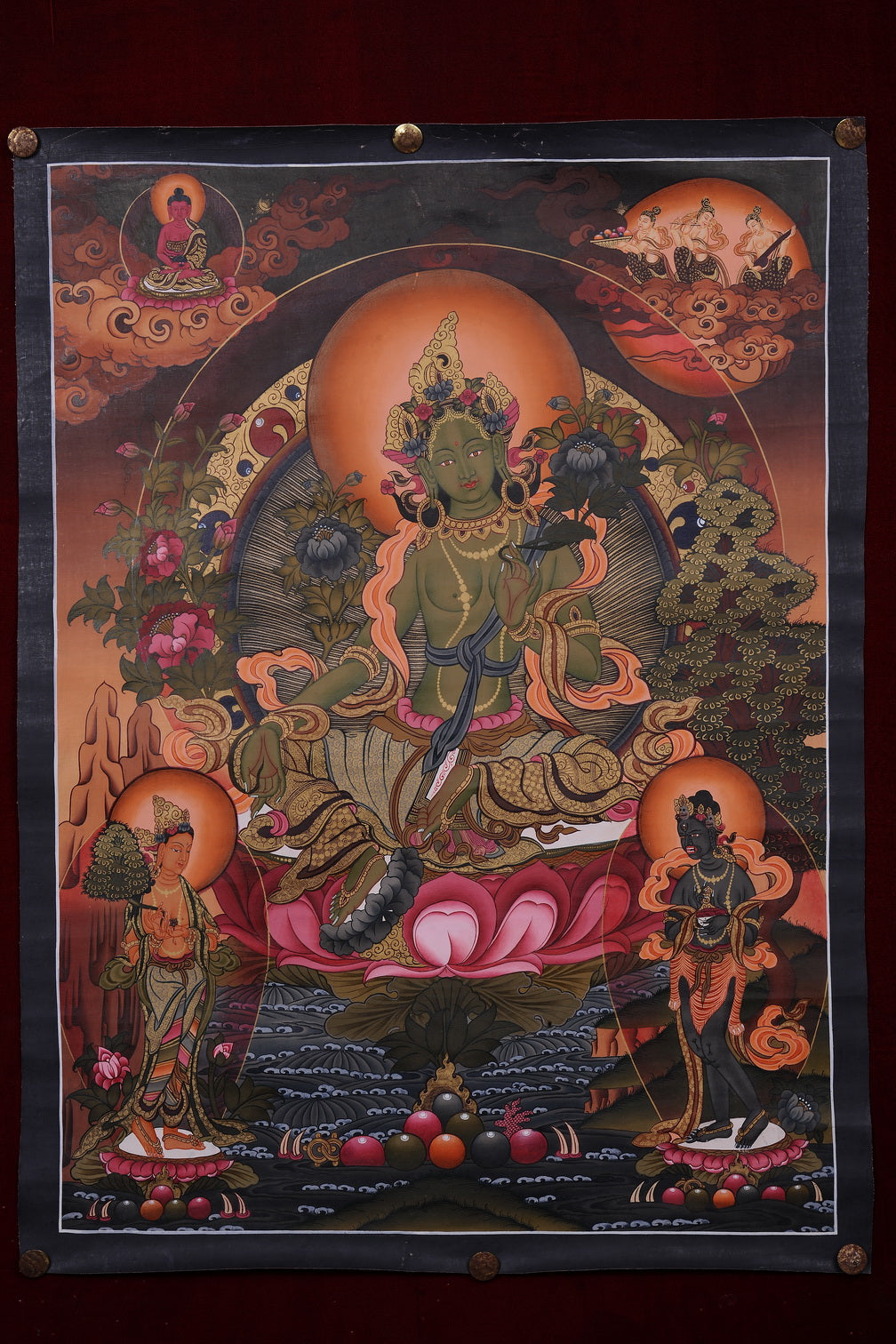
The Exquisite Green Tara Thangka Art (63 x 48 cm) is another hand-painted piece, showing Green Tara adorned with jewels and seated upon a lotus throne, with blue utpala flowers at her shoulders and attendant figures below.
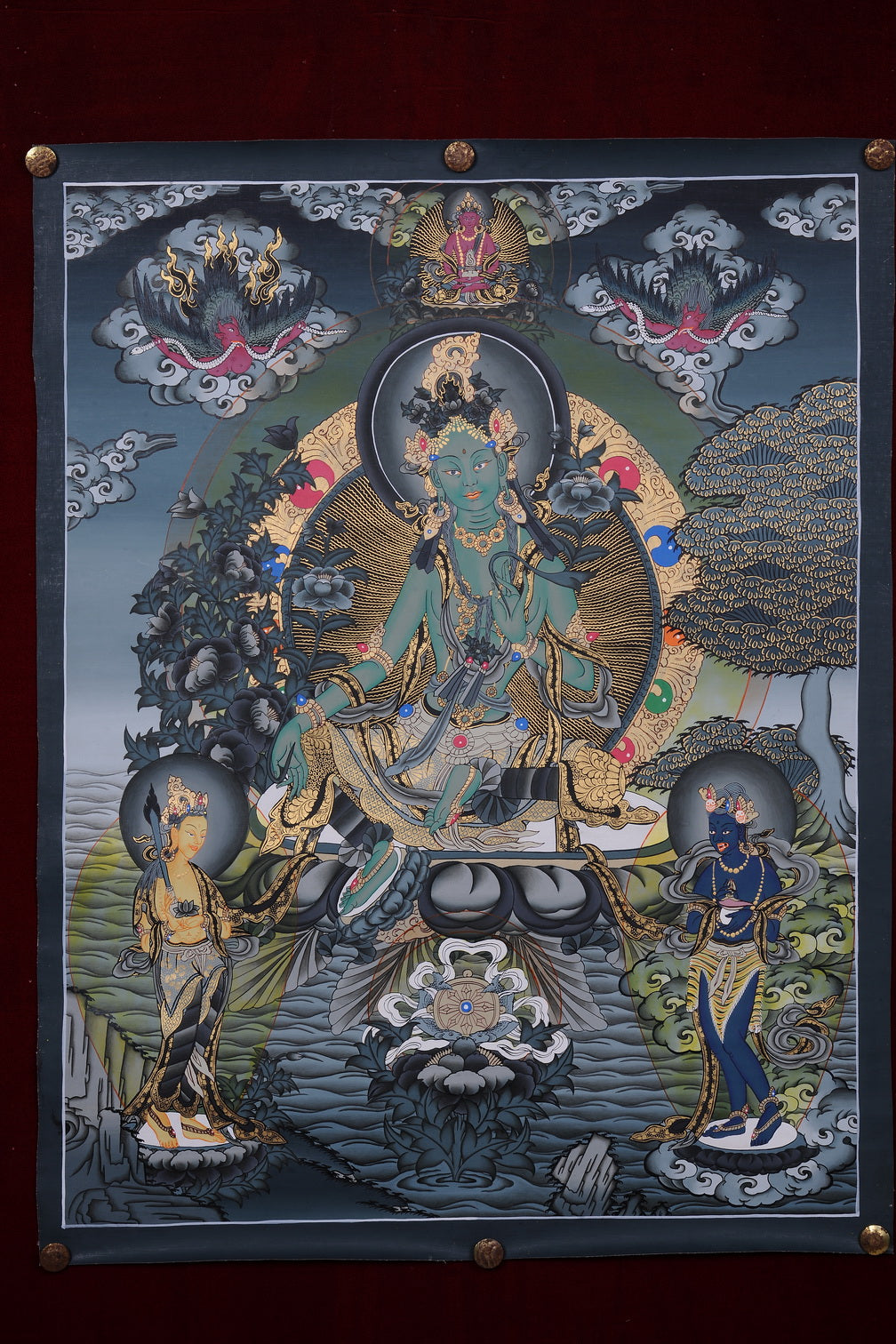
You will find more in our thangka paintings collection.
Sources: Rubin Museum: Green Tara, Himalayan Art Up Close; Rubin Museum, Project Himalayan Art: Tara; Rubin Museum: Green Tara, 15th century; Rubin Museum: Green Tara, 14th century; Himalayan Art Resources: Tara. Dimensions and product details are from our own product descriptions.