
The Buddhist Stupa: Meaning, Relics and Nepal's Watchful Eyes
A stupa is a Buddhist commemorative monument, usually housing sacred relics associated with the Buddha or other saintly persons (Britannica: Stupa). Nepal's Kathmandu Valley is home to two stupas on UNESCO's World Heritage List, as we will see - and the same form, scaled down, is the shape of the two handcrafted stupas in our collection.
From burial mound to sacred architecture
The stupa's hemispherical form appears to have derived from pre-Buddhist burial mounds in India. The classic early example, the Great Stupa at Sanchi, consists of a circular base supporting a massive solid dome - called the anda, "egg", or garbha, "womb" - from which an umbrella projects, the whole encircled by a railing and four gateways (Britannica: Stupa).
From India the idea travelled with Buddhism itself, evolving into such different monuments as the bell-shaped dagaba of Sri Lanka, the terraced temple of Borobudur in Java, the variations of Tibet, and the pagodas of East Asia. Worship at a stupa consists of walking around it in the clockwise direction, and miniature stupas are also used by Buddhists throughout Asia as votive offerings (Britannica: Stupa).
Nepal's stupas and their watchful eyes
The Kathmandu Valley's World Heritage listing covers seven groups of monuments: the Durbar Squares of Hanuman Dhoka (Kathmandu), Patan and Bhaktapur, the Buddhist stupas of Swayambhu and Bauddhanath, and the Hindu temples of Pashupati and Changu Narayan (UNESCO: Kathmandu Valley).
Look up at Swayambhunath or Boudhanath and the stupa looks back. The Eyes of Buddha - half-closed, in a style sometimes called the Adamantine View - are painted on all four sides of the cube at the top of many Tibetan-style stupas, mostly throughout Nepal, to symbolize the Buddha's wisdom seeing all things in the four cardinal directions. Between and slightly above the eyes sits a circle or spiral representing the urna, and directly below it a curly symbol that represents the number one in Devanagari numerals, read either as a nose or as a divine fire from the urna, symbolizing unity (Wikipedia: Eyes of Buddha).
Stupas in our collection
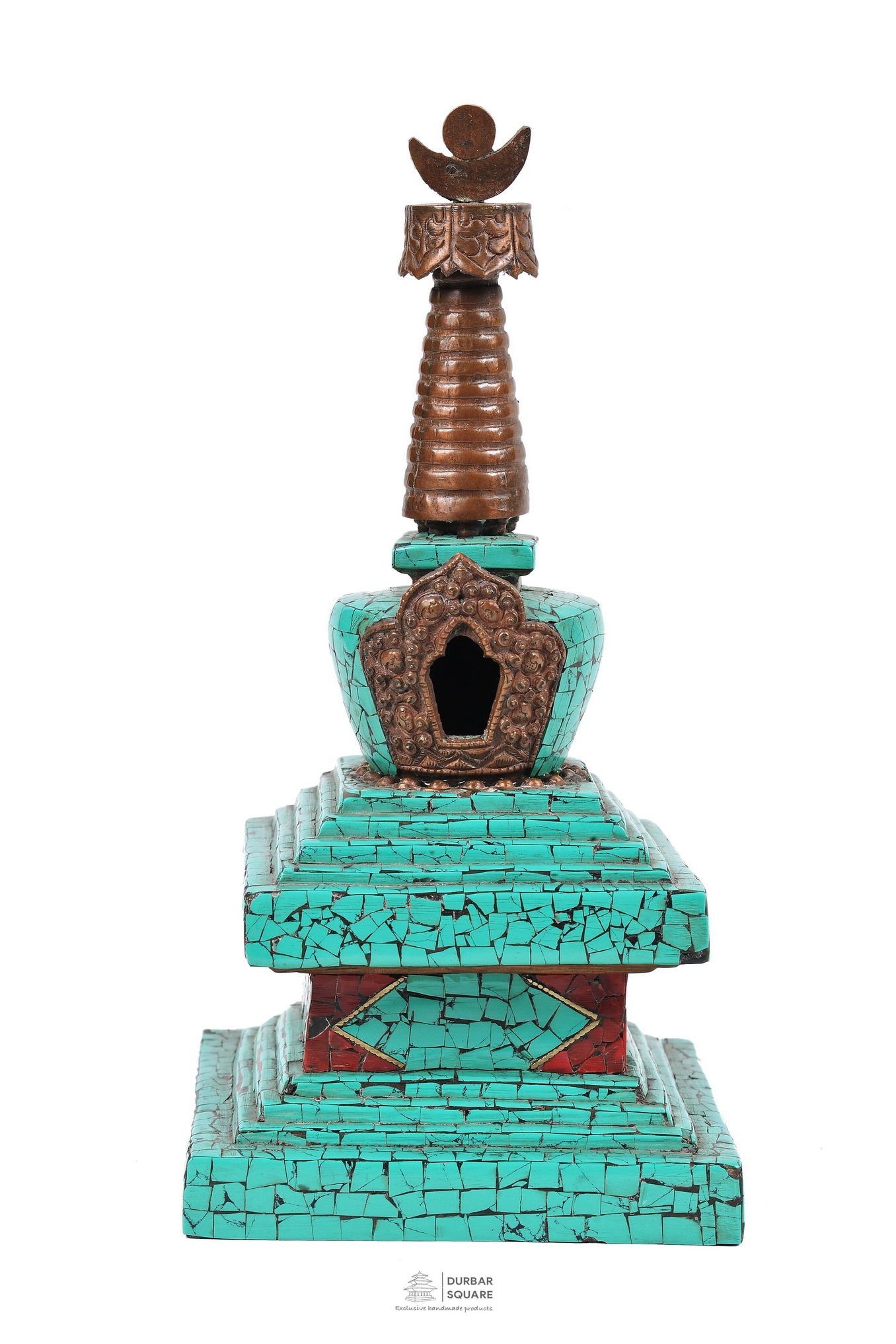
The Buddhist Stupa is, as our product description notes, a handcrafted copper stupa made with coloured Tibetan stones: a stepped, turquoise-tiled base rises to a copper niche, a ringed spire and a crescent-and-disc finial.
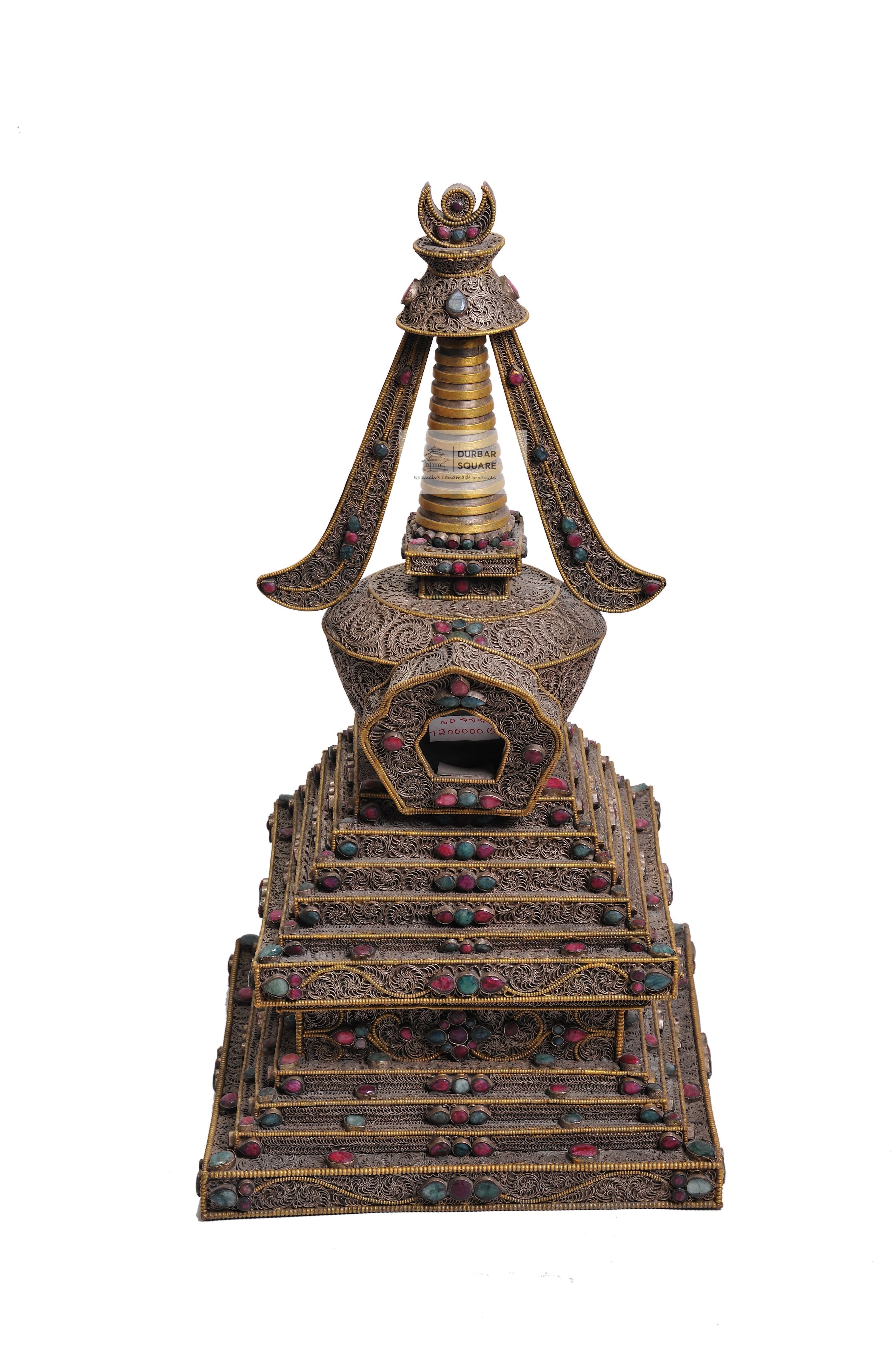
The Stupa with Filigiri Carvings works the same form in ornate copper filigree set with rubies, emeralds and quartz, with two hanging filigree banners from the spire.
You will find them in our decoratives collection.
Sources: Britannica: Stupa; UNESCO World Heritage Centre: Kathmandu Valley; Wikipedia: Eyes of Buddha. Materials and details of the two stupas are from our own product descriptions.