
Buddha Head Statues: What the Features Mean
A Buddha statue is never just a likeness. Across Buddhist art, the way the Buddha is shown follows shared conventions, and Wikipedia's article on the Buddha in art notes that despite cultural and regional differences, there are general guidelines for the attributes of a Buddharupa, a Buddha image. Buddha head statues concentrate those conventions into a single form: the head alone carries several of the marks by which an image of the Buddha is recognized. This guide explains what those features mean, when artists first began depicting the Buddha at all, and how the form appears in pieces from our own collection.
The features and what they mean
The ushnisha. The bump at the top of the Buddha's head is called the ushnisha. According to Wikipedia's article on the ushnisha, it is the thirty-second of the 32 major marks of the Buddha, described as a fleshy or cranial protuberance at the top of his head, and it is sometimes elaborated that it is covered with hair that curls to the right. Wikipedia's Buddha-in-art article says the ushnisha represents spirituality, wisdom, and awakening.
The hair. As noted above, the ushnisha is sometimes described as covered with hair that curls to the right. Rather than flowing hair, Buddha heads are carved with tight curls, and in the three pieces from the collection shown below, the curls cover the whole head.
The elongated earlobes. Wikipedia's Buddha-in-art article explains that the elongated earlobes are vestiges of the Buddha's life as a prince, when he wore extravagant jewelry. Long ears on a statue are therefore a reminder of the worldly wealth he left behind.
The eyes and expression. Many Buddha heads are carved with half-closed eyes and a faint, composed smile. As the description of the onyx Buddha head in our own collection puts it, the half-closed eyes suggest a state of meditation, looking inward as well as outward. That reading comes from the store's product description rather than an art-historical source, but it matches what the carved faces show.
When did artists begin depicting the Buddha?
Images of the Buddha have a traceable beginning. Wikipedia's Buddha-in-art article states that the image of the Buddha started to emerge from the first century CE in North India, developed in the regions of Gandhara and Mathura. The art of Gandhara was influenced by Ancient Greek art, which led to the Greco-Buddhist style with its anatomically well-proportioned and realistic figure of the Buddha. From India, the depiction of the Buddha spread to the rest of Asia, and each region developed its own variations in clothing, posture, and style.
Why a head alone?
There is no single authoritative explanation for the Buddha head as a standalone form, and we will not invent one. One way to read it is practical: the marks that identify an image as the Buddha, the ushnisha, the curls, the elongated earlobes, the meditative expression, all sit on the head, so the head alone can carry the full identity of the figure. Our own product descriptions present the Buddha head as one of the most popular iconographic representations of the Buddha, which is the store's framing rather than an art-historical verdict.
Buddha head statues in the Durbar Square collection
We carry Buddha heads in several materials and finishes. Three examples, described as their listings and photos show them:
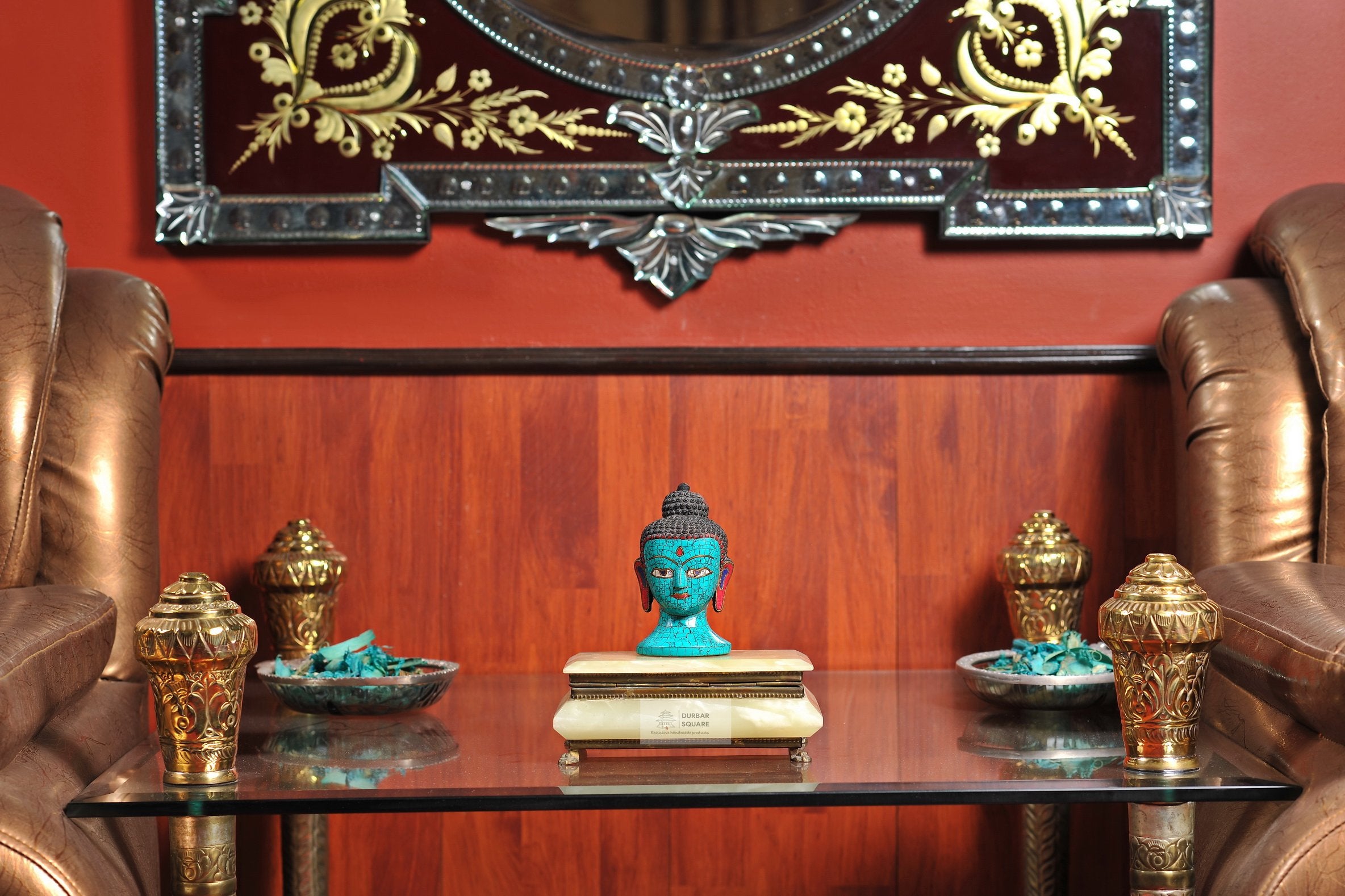
Buddha Head, $110. The listing describes it as a handcrafted Buddha head with various Tibetan stones. The photo shows a small turquoise-finished head with tight curls, elongated earlobes, and a clearly raised ushnisha, presented on a cream stand.
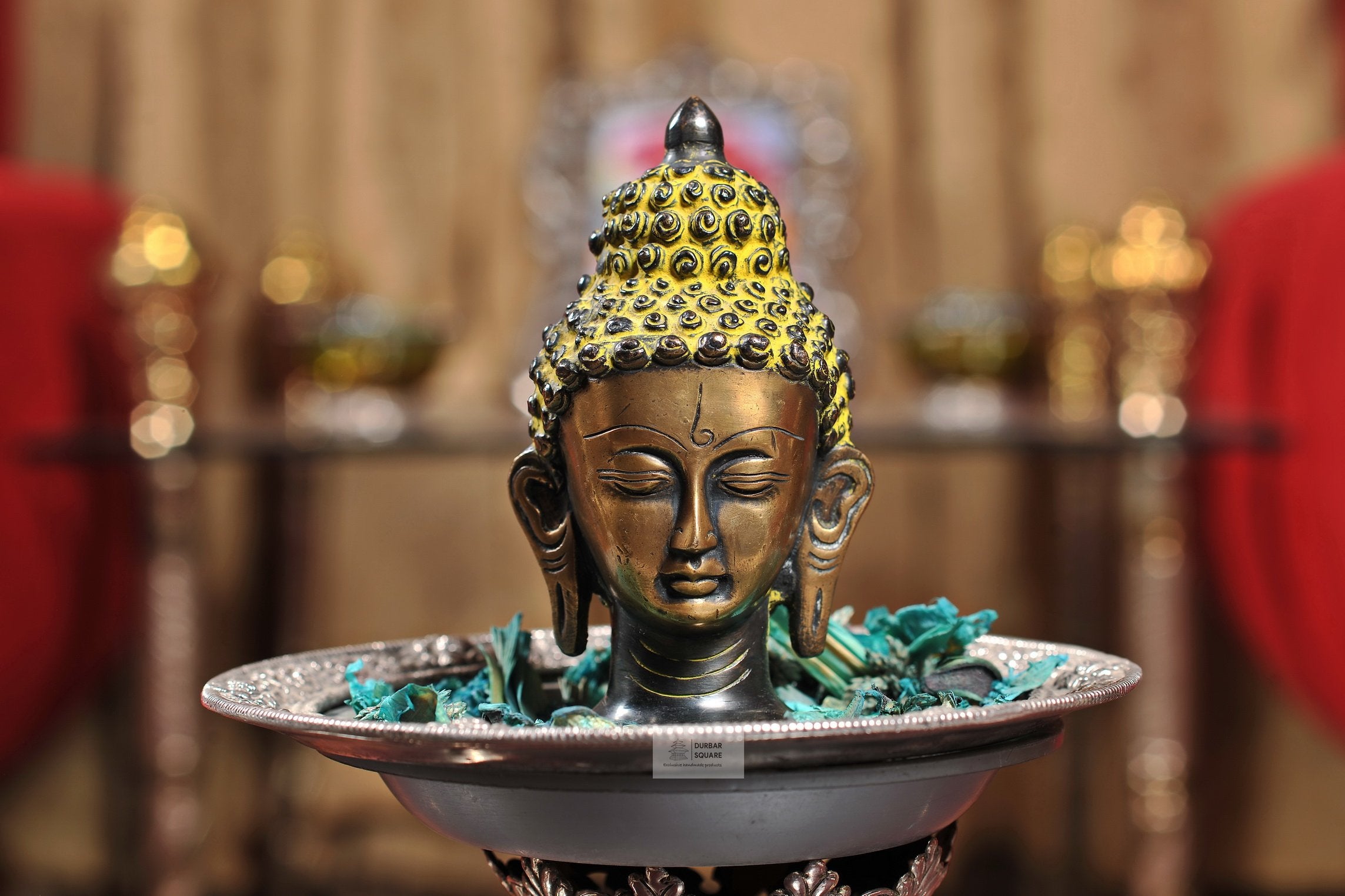
Bronze Buddha Head, $137. A handcrafted bronze Buddha head, per its listing. In the photo, golden curls sit above a warm bronze-toned face with downcast eyes and long earlobes.
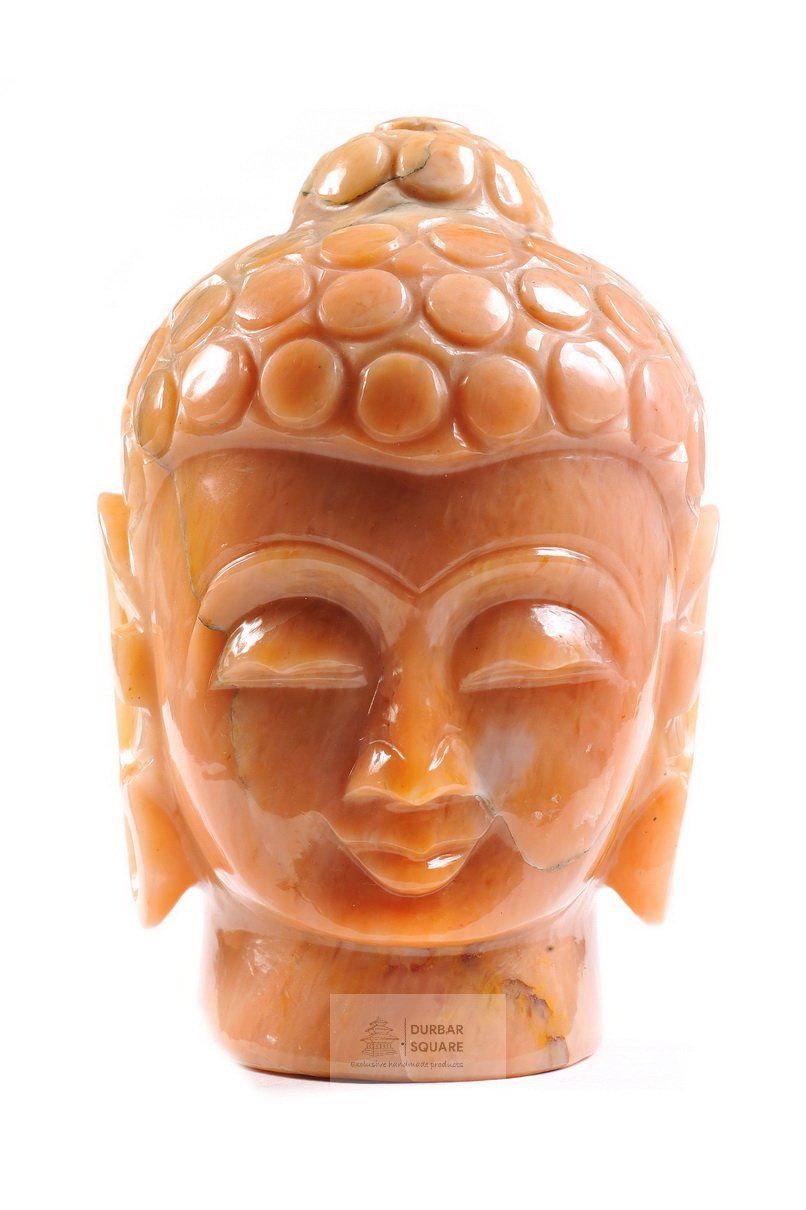
Buddha Head carved out of Onyx stone, $404. The listing describes a handcarved Buddha head carved from orange onyx stone, carved and finished by hand. The photo shows the stone's honey-orange tones and natural banding, with rounded curls and half-closed eyes.
You can browse more pieces in the store's statue collection.
Sources
- Wikipedia: Buddha in art (Buddharupa) - attributes of Buddha images and the emergence of Buddha depictions in first-century-CE Gandhara and Mathura
- Wikipedia: Ushnisha - the ushnisha as the thirty-second of the 32 major marks of the Buddha
Product details and prices are from the current Durbar Square listings at the time of writing and may change. Interpretations of individual pieces reflect the store's own product descriptions.