
Avalokiteshvara: Meaning and Iconography of the Bodhisattva of Compassion
If one figure in Himalayan Buddhist art stands for compassion, it is Avalokiteshvara. Wikipedia gives the name's meaning as "the Lord who looks down", and records his other names too: Lokeshvara, "Lord of the World", and Chenrezig in Tibetan. He is the bodhisattva associated with Great Compassion, mahakaruna, and his image runs through the Durbar Square range in both thangka paintings and statues.
A bodhisattva of many forms
Wikipedia's account describes 33 different manifestations of Avalokiteshvara, including female forms, each suited to the minds of different beings. In East Asian Buddhism the bodhisattva takes a female form: Guanyin in Mandarin Chinese, Kannon in Japan, Gwaneum in Korea and Quan Âm in Vietnam. In Tibet he is Chenrezig, also spelled Spyan-ras gzigs, which Wikipedia translates as "With a Pitying Look". Tibetan Buddhist tradition also links him to Tara: Wikipedia recounts that Tara came into existence from a single tear shed by Avalokiteshvara, and that when the tear fell to the ground it created a lake, with a lotus opening in the lake to reveal Tara.
Om mani padme hum
In Tibetan Buddhism, the central mantra tied to Avalokiteshvara is the six-syllable Om mani padme hum, also called the Mani mantra, Wikipedia notes. The same article describes a popular practice built around it: prayer wheels, spun clockwise, that contain numerous repetitions of the mantra.
Reading the forms
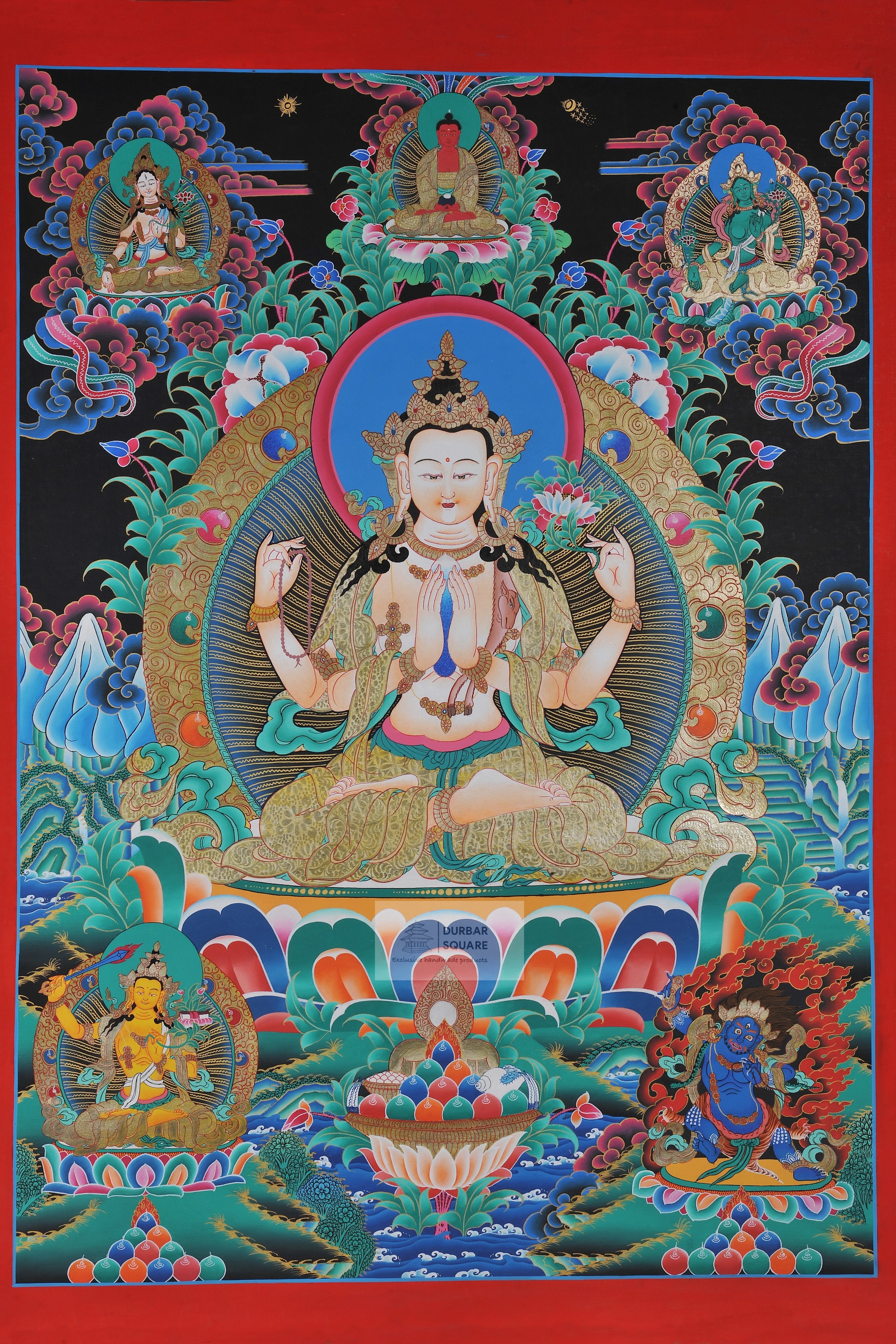
Two forms appear again and again in Himalayan art. Wikipedia links the four-armed Avalokiteshvara, Catur-bhuja, to the Om Mani Padme Hum mantra. The thousand-armed form, it notes, is often depicted with eleven heads and eyes on the palms, a manifestation also known as Ekadashamukha. In Mahayana and Vajrayana Buddhism, the article adds, Avalokiteshvara is considered a manifestation of Amitabha Buddha.
Avalokiteshvara in the Kathmandu Valley
The bodhisattva appears in the Kathmandu Valley's own tradition. Wikipedia records clay images of Amoghapasha Lokesvara, flanked by Arya Tara and Bhrikuti Tara, enshrined in a monastery in Patan, and notes that this set of images is popular in the traditional monasteries of the Kathmandu Valley.
The Avalokiteshvara pieces at Durbar Square
The hand-painted Avalokiteshvara Thangka ($1,250) shows the four-armed form seated on a lotus; the listing describes White and Green Tara, Amitabha Buddha, Manjushri and Bhairav around the central figure, painted in vegetable colour with gold. The Gold Plated Avalokiteshvara Statue ($2,754) is the standing eleven-headed, thousand-armed form, handcrafted in copper with a full gold-plated finish and an antique look, per its listing; a small Buddha figure crowns the stacked heads, which the listing identifies as Amitabha.
Sources
- Wikipedia: Avalokiteshvara (name meanings, Great Compassion, the 33 manifestations, Guanyin and Kannon, Chenrezig, the Tara tear story, the Mani mantra and prayer wheels, the four-armed and eleven-headed thousand-armed forms, the Patan images)
- Durbar Square product listings (materials, finishes, the surrounding figures in the thangka, and prices)