Nataraja (Natraj): The Meaning of Shiva's Cosmic Dance
A four-armed figure dancing inside a ring of fire: that is Nataraja, Shiva as the Lord of the Dance, and every detail of the pose carries meaning. Here is what the form shows, where it comes from, and how to read a Natraj statue of your own.
Who is Nataraja?
Wikipedia describes Nataraja as a depiction of Shiva, one of the principal deities of Hinduism, in the role of the divine cosmic dancer; the dance he performs is called the tandava. The name itself is Sanskrit, combining "nata" (act, drama or dance) with "raja" (king or lord), and the term can be roughly translated, per Wikipedia, as "Lord of the dance". Wikipedia notes that the depiction appears in all major Shaivite Hindu temples and is a well-known sculptural symbol in India, describing it as one of the finest illustrations of Hindu art.
Reading the iconography
The classic Nataraja image packs its meaning into a small set of repeated details. As Wikipedia lays them out:
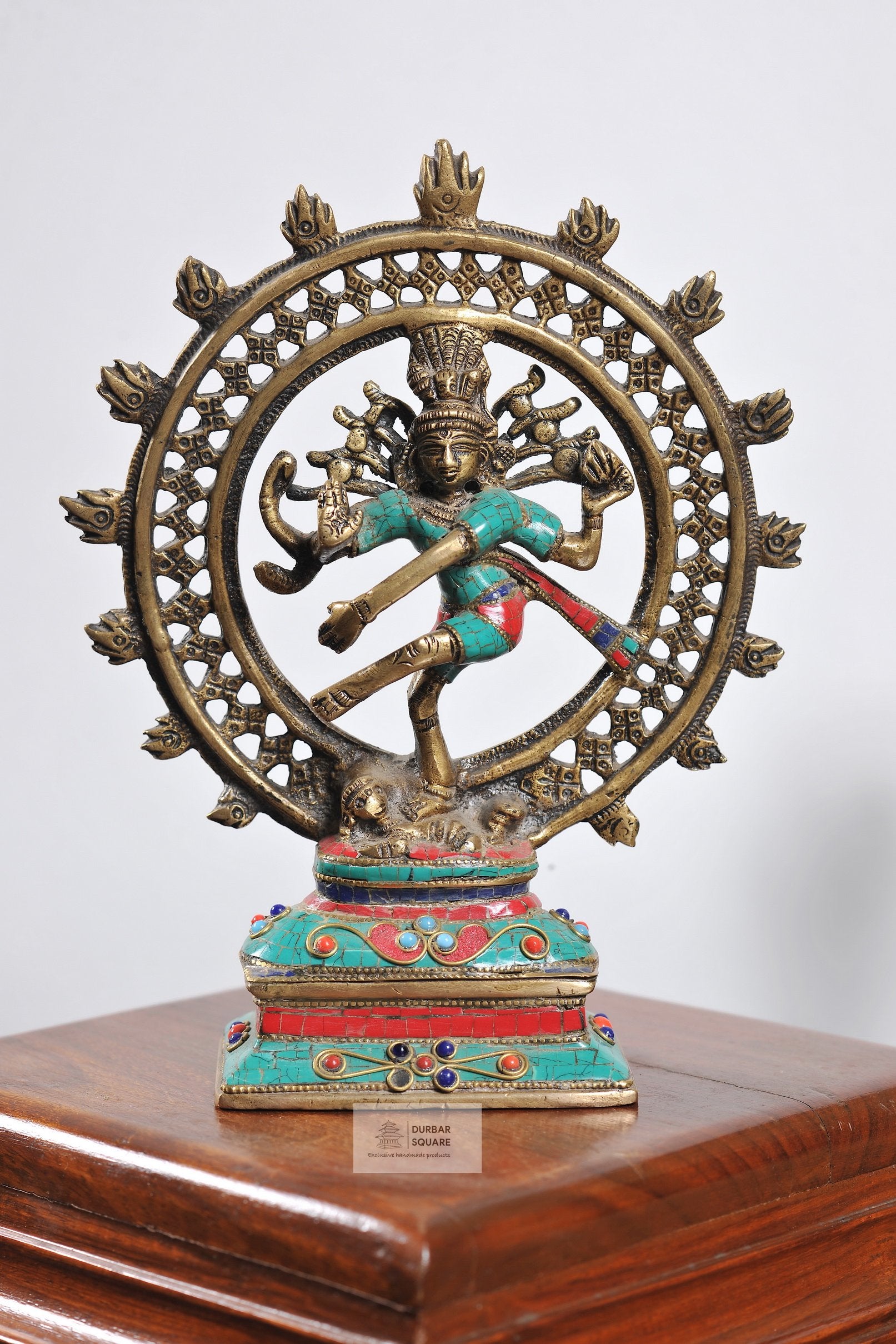
- The ring of flames (prabha mandala) that circles the dancer stands for the cosmic fire which, in Hindu cosmology, both creates and consumes everything in cyclic existence.
- The small drum (damaru) in the upper right hand symbolizes the rhythm of creation and time.
- The flame (agni) held in the upper left hand signifies destruction.
- The lower right hand, with a cobra uncoiling from the forearm, forms the abhaya mudra, the gesture of "do not fear".
- The lower left arm crosses the chest, a pose read as tirodhana, "concealment".
- The dwarf underfoot is the demon Apasmara, who symbolizes the spiritual ignorance that Nataraja destroys.
- The third eye on the forehead has been interpreted as the inner eye of knowledge.
Wikipedia adds that four-armed figures are the most typical, that the dancer balances on a lotus pedestal, and that his matted hair streams out as a fan behind his head with the personified river Ganges typically meshed into its strands, while the headdress often features a human skull, a crescent moon and a datura flower. These are the standard elements; details vary by period and region.
Creation and destruction in one dance
Wikipedia describes two common forms of Shiva's dance: the lasya, a gentle form associated with the creation of the world, and the ananda tandava, the vigorous "dance of bliss" associated with the destruction of weary worldviews. In Wikipedia's summary of the tradition, the two are aspects of one nature: Shiva destroys in order to create, tearing down to build again. That is why the same small statue can hold a drum (creation's rhythm) in one hand and fire (destruction) in another.
A short history
Stone reliefs at the Ellora and Badami cave temples, dated by around the 6th century, are among the oldest Nataraja sculptures in India, according to Wikipedia. The form reached its best-known expression in the Chola bronzes of Tamil Nadu around the 8th to 10th centuries; despite being called "bronzes", Wikipedia notes these works are mostly copper, with some brass, cast by the lost-wax (cire-perdue) process. The image traveled: Nataraja reliefs are found at Angkor Wat and in Bali, Cambodia and Central Asia, and Wikipedia records medieval-era artworks and texts on the dancing Shiva from Nepal, Assam and Bengal, where he is sometimes shown dancing on his bull Nandi and is regionally known as Narteshvara. In 2004, a 2-meter statue of the dancing Shiva was unveiled at CERN, the particle physics center in Geneva, as a gift from the Indian government.
What the dance means
Interpretations have accumulated for centuries, and Wikipedia is careful to record that scholars do not all read the image the same way. One reading, summarized by Ananda Coomaraswamy, holds that the dance is the rhythmic play behind all movement in the universe, that its purpose is to release souls from illusion, and that its setting is ultimately within the heart. Other scholars have argued the statues may have meant different things to different people or in different contexts, such as an emblem of the Chola dynasty or Shiva as lord of the cremation ground. Treat any single reading, including this one, as one lens rather than the final word.
Natraj and Shiva statues at Durbar Square
Durbar Square carries a handcrafted bronze Natraj statue inlaid with various semi-precious stones, priced at $178. The store's own description presents Shiva Nataraja as the Lord of the Dance within a circle of fire, performing the tandava, and notes the crescent moon, skull and datura blossom in his hair. In the listing photo you can see the dancer inside a circular openwork aureole, one foot resting on a small figure, with turquoise and red stone inlay across the body and base.
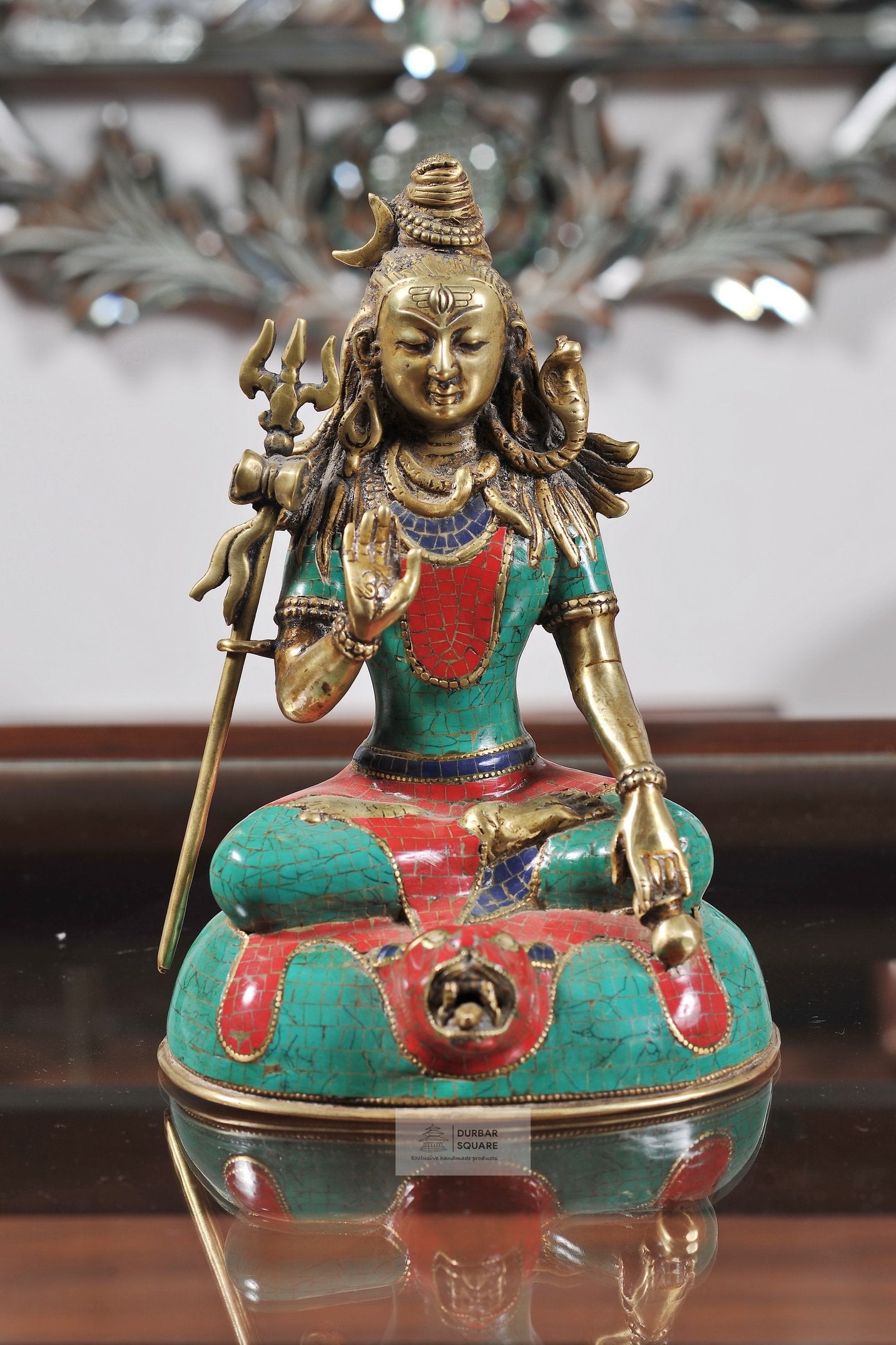
For a stiller aspect of the same deity, the store also carries a handcrafted bronze Shiva statue with semi-precious stone inlay at $259, shown seated with his trident. Both pieces appear in the store's Statues of Hindu Deities collection.