
Kalash: The Pot of Abundance in Hindu and Buddhist Ritual
A kalasha is, in Wikipedia's definition, a metal pot - brass, copper, silver or gold - with a large base and a small mouth. The same source records that it is employed in the rituals of the Hindu, Jain and Buddhist traditions as a ceremonial offering to a deity or an honoured guest, and as an auspicious symbol used to decorate shrines and buildings. Here is what the pot and its full ritual arrangement mean, and a look at one handcrafted copper example from the store.
The Purna-Kalasha: pot, leaves and coconut
Wikipedia notes that "kalasha" sometimes refers to the pot filled with water and topped with a coronet of mango leaves and a coconut, a combination often used in Hindu rites and depicted in Hindu iconography. The whole arrangement is called Purna-Kalasha, Purna-Kumbha or Purna-ghata, each name literally meaning "full or complete vessel". According to the same source, the pot is sometimes filled with coins, grain, gems or gold instead of water; the coronet counts 5, 7 or 11 mango leaves placed so their tips touch the water; and the coconut is sometimes wrapped in red cloth and red thread with its top, the Shira or "head", kept uncovered and facing the sky.
What the kalash stands for
Wikipedia records that the kalasha is believed to contain amrita, the elixir of life, and is viewed as a symbol of abundance, wisdom and immortality; in Hindu iconography it appears as an attribute in the hands of Brahma, of Shiva as teacher, and of Lakshmi. The Purna-Kalasha, in the same account, is taken as a symbol of auspiciousness embodying Ganesha, Gauri or Lakshmi, and is worshipped in Hindu festivities related to marriage and childbirth. In that context, Wikipedia glosses each part: the metal pot as a container of fertility, the earth and the womb; the mango leaves as the pleasure aspect of fertility, associated with Kama; the coconut as prosperity and power; and the water as the life-giving ability of nature. A further reading the source records maps the arrangement onto the five elements: the wide base as earth, the expanded centre as water, the neck as fire, the mouth as air, and the coconut and leaves as aether.
A closer look: the store's copper kalash
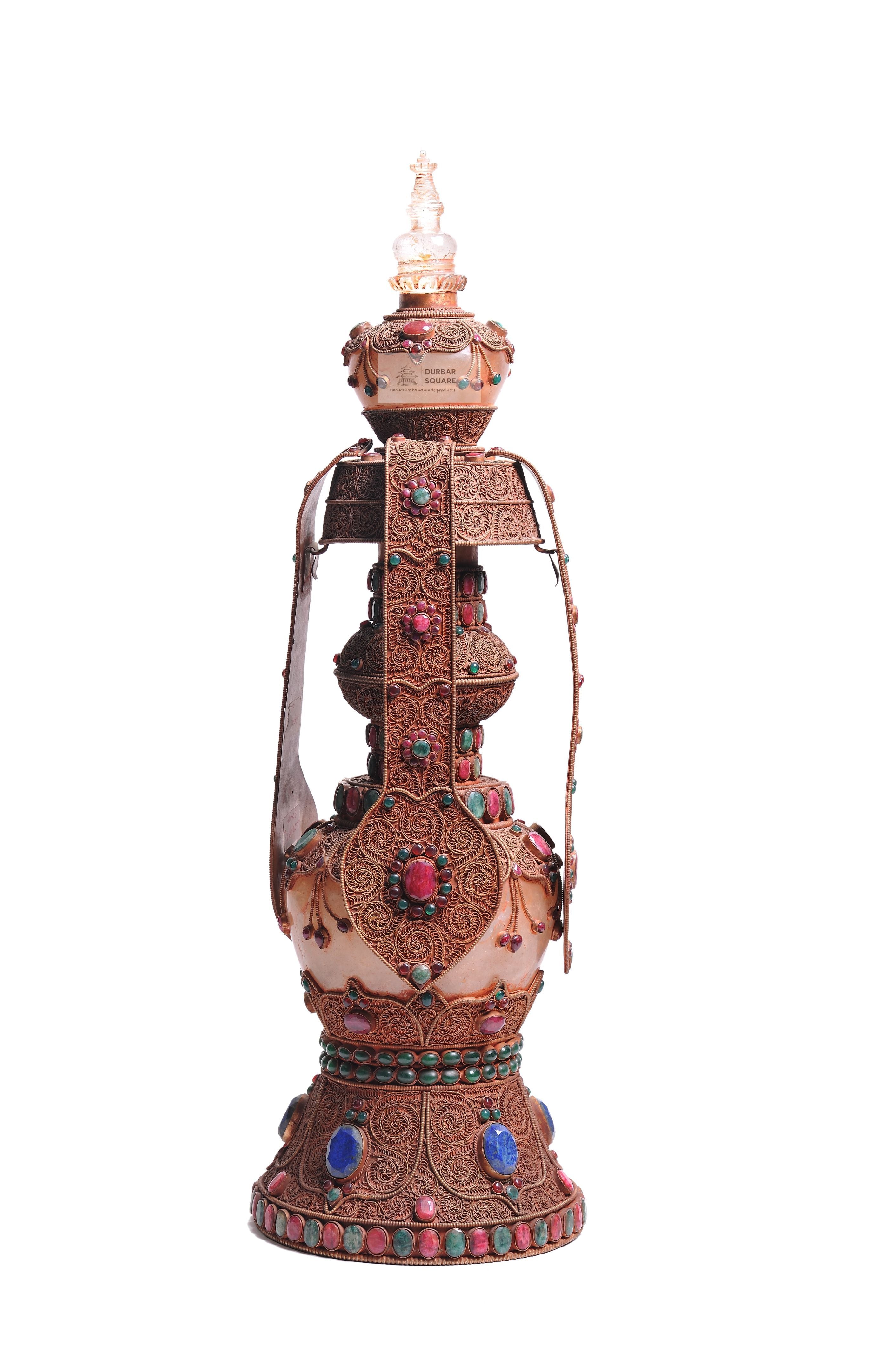
The store's Kalash ($2,119) is described in its listing as a handcrafted copper kalash with filigree carvings set with rubies, emeralds and quartz, engraved with the mantra "Om mane padme hom". In the photo, the pot rises in the classic large-base, small-mouth form, its copper surface worked in dense filigree scrolls and studded with red, green and blue stone cabochons, with a pale crystal finial crowning the lid and straps hanging at the sides.
Related reading
For the vessel traditions on the Buddhist side of the Himalaya, see our article on kamandalu, surahi and other Himalayan water vessels.