
Ardhanarishwar: The Meaning of Shiva's Half-Woman Form
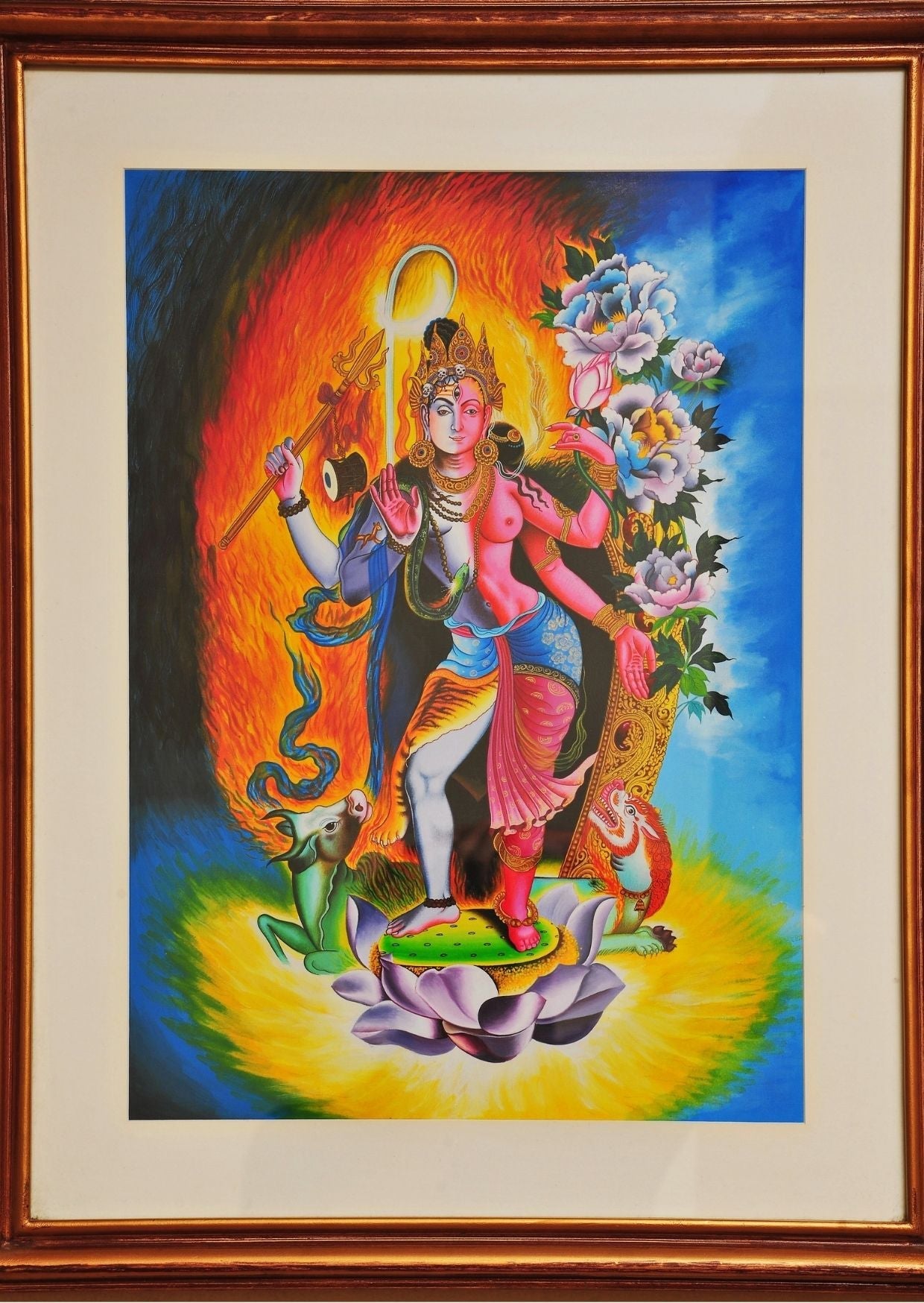
The god who is half woman
Ardhanarishwar is one of the most striking ideas in Hindu art: a single figure that is half Shiva and half Parvati, joined down the middle. The name says it plainly. In Sanskrit, ardha means half, nari means woman, and ishwara means lord: the lord who is half woman.
The form is not a puzzle or a curiosity. It is a statement, and once you know how to read the two halves, the whole figure opens up.
Reading the two halves
Read the figure from the centre outward. One side belongs to Shiva the ascetic: matted hair, a third eye, animal skin, serpents worn as ornaments. The other side belongs to Parvati: dressed hair, fine silk, jewellery. The contrast is the point. Austerity and stillness on one side, warmth and abundance on the other, in one body.
What it means
One widely shared reading of the figure is unity: the male and female principles as two halves of one whole, neither complete without the other.
It is also a family image. Shiva and Parvati are husband and wife, and their fused form has long been read as an ideal of partnership, two natures in one body, without one erasing the other.
In art
Ardhanarishwar appears across Indian and Southeast Asian art, above all in sculpture, and also in painting. Our hand-painted Ardhanarishwar is painted in Nepal, framed and measuring 25 by 20 inches. You can see it here:
Source: Encyclopaedia Britannica, "Ardhanarishvara", checked Oct 19, 2026.